EVERLEGAL and partners hosted an international webinar on the expansion of Ukrainian Defence Tech companies into European markets

EVERLEGAL and partners hosted an international webinar on the expansion of Ukrainian Defence Tech companies into European markets
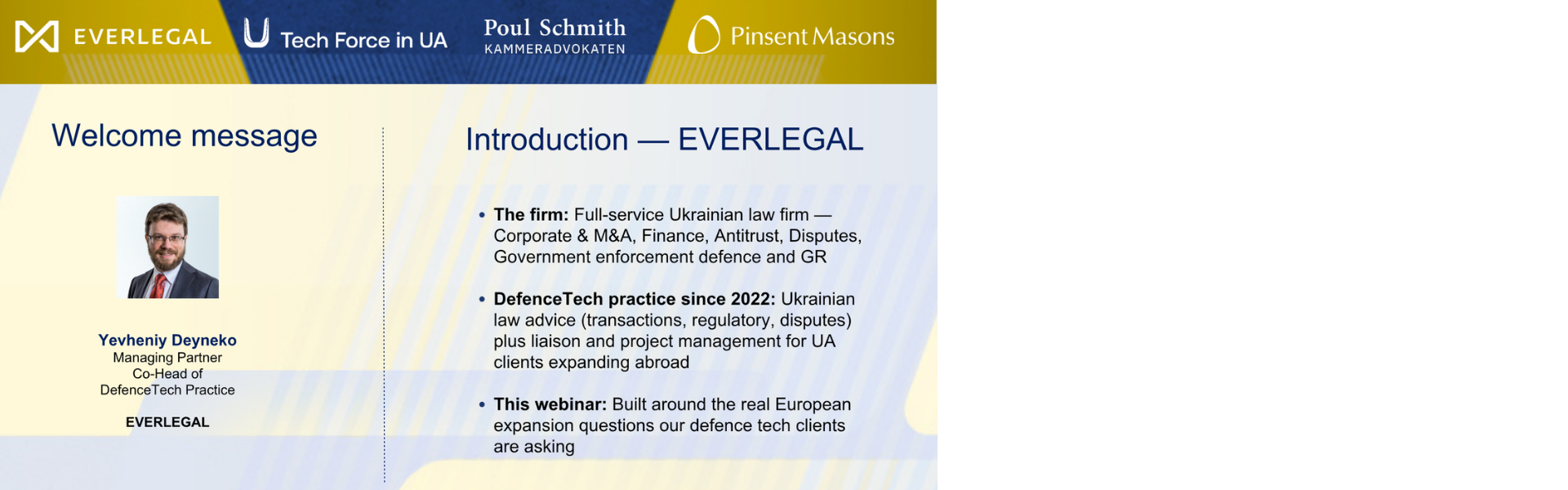
EVERLEGAL, together with Tech Forces of Ukraine, Pinsent Masons and Poul Schmith/Kammeradvokaten, hosted the international webinar “Ukrainian Defence Tech Expansion into Europe: UK, Netherlands, Germany and Denmark”. The event brought together more than 50 participants, representatives of Ukrainian defence companies exploring entry into European markets.
The webinar was moderated by Yevheniy Deyneko, Managing Partner of EVERLEGAL and Co-Head of the DefenceTech Practice. Speakers were legal practitioners from four jurisdictions:
- Andrew Brydon, Partner & Global Defence Lead, Pinsent Masons (United Kingdom)
- Jeroen Schouten, Partner, Pinsent Masons (The Netherlands)
- Anton Sadykov, Senior Associate, Pinsent Masons (Germany)
- Tomas Ilsøe Andersen, Partner, Poul Schmith/Kammeradvokaten (Denmark)
Context
Participants noted a fundamental shift in how European partners perceive Ukraine. Two to three years ago, the central question was how to support Ukraine. Today, Ukrainian defence technologies, including drones, AI, unmanned systems and adaptive logistics, are regarded as assets that Europe seeks to integrate into its own defence capabilities. At a recent NATO conference in Munich, a German general put it plainly: "In the past, we had no money, but plenty of time. Now we do have money, but no time."
Market Entry: Key Considerations by Jurisdiction
The United Kingdom operates the most flexible regulatory regime of the four jurisdictions. Ukrainian ownership is permitted without restriction, and no specific permits are required for basic operational activity in the defence industry. The Ministry of Defence has established a dedicated unit to assist Ukrainian companies entering the British market. R&D grants are fully accessible to companies with Ukrainian ownership. NATO Secret-level clearance takes 12–13 months even for British nationals, and this must be factored into planning from day one.
Denmark formally has the longest list of permits, covering establishment, production and export, with additional requirements relating to board composition and company management. In practice, all permits are processed within weeks due to political prioritisation. At the time of the webinar, 5–8 Ukrainian defence companies were already operating in Denmark. FDI screening takes 12 weeks.
In the Netherlands, FDI screening is triggered when a foreign investor establishes a joint structure involving sensitive technologies, military goods or dual-use products. The review period is 8 weeks. A mandatory prerequisite for any transaction is sanctions screening of all parties.
Germany has the lowest threshold for triggering screening: for defence sector companies, it applies from a 10% shareholding. The standard operating vehicle, a GmbH, is typically ready for operation within 4–6 weeks. Despite the formal rigour of the regime, Ukrainian investors currently benefit from political goodwill and the number of German-Ukrainian joint ventures in the defence sector continues to grow.
Corporate Structure and Export Controls
Speakers from all four jurisdictions recommend the same model: Holdco + Opco. R&D is best kept in Ukraine, as European partners are particularly interested in accessing Ukrainian battlefield-tested developments. Manufacturing and export licensing functions are placed in a separate legal entity within the EU. A critical point: export controls apply not only to the physical movement of goods, but also to the transfer of technology by electronic means, including e-mail, cloud platforms and remote access.
Defence Sector Investment
ESG restrictions on defence sector investment are being formally lifted: the UK's Financial Conduct Authority (FCA) has confirmed that such investments are acceptable under ESG frameworks. Goldman Sachs and Morgan Stanley are actively seeking opportunities in the defence sector.
Key Takeaways
Speakers were aligned on one point: the most common mistake Ukrainian companies make when entering European markets is starting the regulatory planning process too late. Export permits, FDI screening and security clearances all take time and must be built into the plan from day one, not after operations have launched. Local presence and partnership with established local players significantly ease access to procurement procedures and reduce regulatory risk.
EVERLEGAL advises Ukrainian companies on the establishment and structuring of defence tech businesses in Ukraine and abroad.
- For enquiries and consultations, please fill out a short form on the website.
- More information about Yevheniy Deyneko, Managing Partner at EVERLEGAL, is available via the link.